Where it started
After Teddy lost the use of his back legs on June 30, 2025, rehab began with the simplest things: regular home massage for his hind legs, acupuncture, and hyperbaric oxygen therapy in Taiwan. Slowly, he went from no movement in his hind legs to showing voluntary movement in them — the first small sign that the work was doing something.
Hydrotherapy — the tank he hates
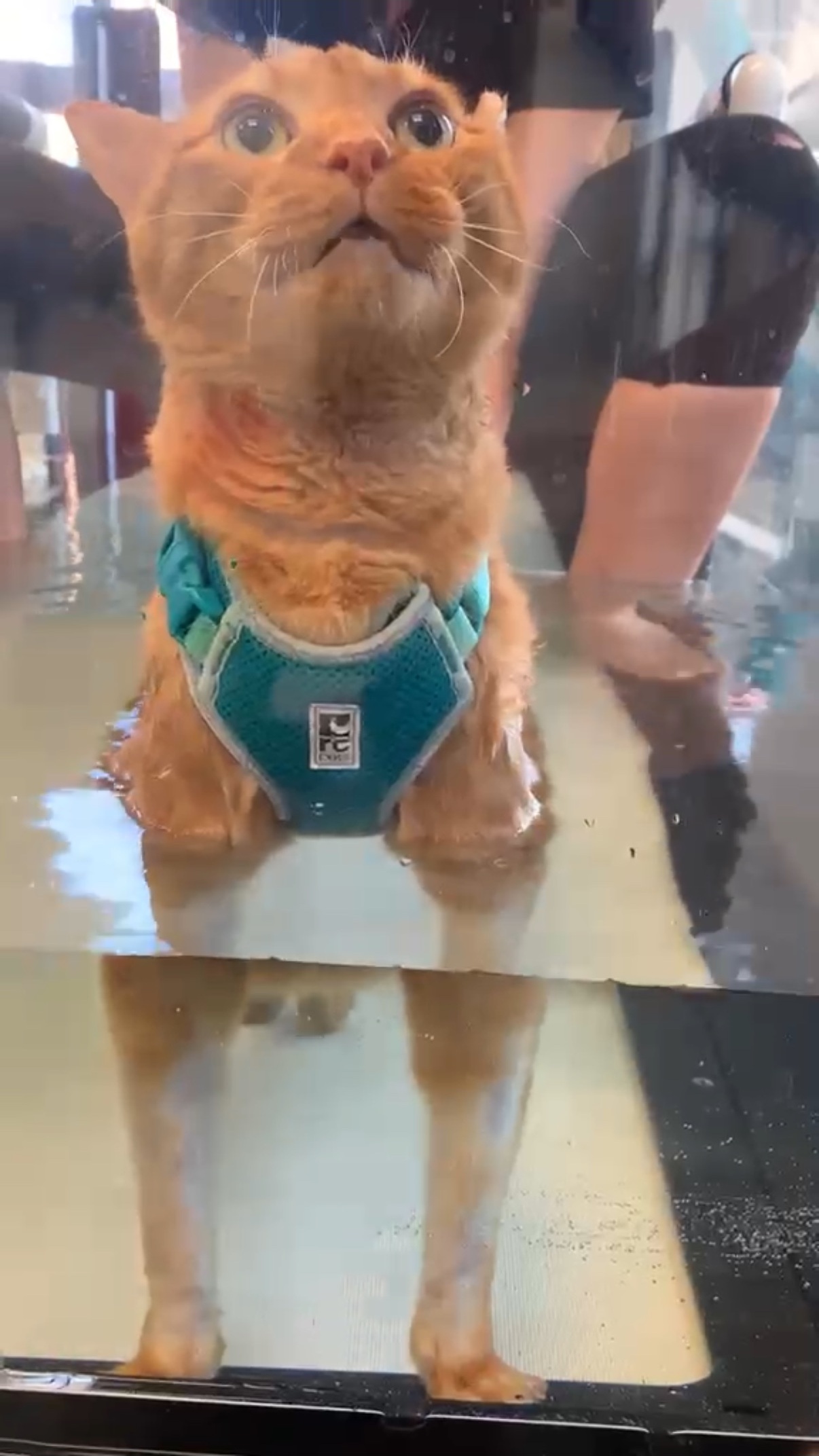
At Four Paws Rehab in Toronto, part of Teddy's rehab is hydrotherapy — walking in a water tank. Let's be honest: he hates the water, and he makes his feelings known. He walks the tank under protest, and he is not shy about it.
Laser therapy — the one he likes
Not everything in rehab is a battle. Teddy genuinely enjoys his laser therapy sessions — one of the few treatments he doesn't protest. It is a small mercy in a routine full of hard work.
A few seconds standing
During treatment in Taiwan, Teddy once stood up on his own for a few seconds. There is no video of it — just his family's memory of the moment. After the move back to Canada in December 2025, he lost that ground. It is a moment we remember, not a promise. Nobody knows if he will stand again, and no vet has ever said he will.
Rehab today
These days Teddy goes to Four Paws Rehab on Queen Street West in Toronto every one to two weeks, and does ten to fifteen minutes in his wheelchair every morning at breakfast. The wheelchair itself is now in its third generation: the first was one his family made by hand, and it helped his rehab a great deal. The second, ordered after the move to Canada, had only two rear wheels and no front support — and unlike most paralyzed cats, Teddy's front legs can't carry his full weight, so he tired quickly. The third, a four-wheel wheelchair ordered recently, is still being fitted — his family is drawing on everything they've learned to make it as comfortable as it can be. And in it, something new is happening: his hind feet are stepping along, paws on the ground, one after the other.
It is a small thing, and we are careful not to make it a big claim. It is simply what his feet do in the chair, on a good day, with support.
What rehab is for
Rehab isn't about chasing a miracle. It's about strength, weight, comfort, and a good daily life — keeping Teddy as strong and comfortable as he can be. His neurologist has noted strong voluntary movement in his hind legs. That is an observation, not a promise — and we treat it that way.
The hope is his mom's. The work is Teddy's. One session at a time.